

Greer, SC · What we treat
Say what hurts. We’ll take it from there.
Nobody walks in already speaking clinical. Find the phrase that sounds like your week below, or the body part that’s been complaining, and read what it usually turns out to be.
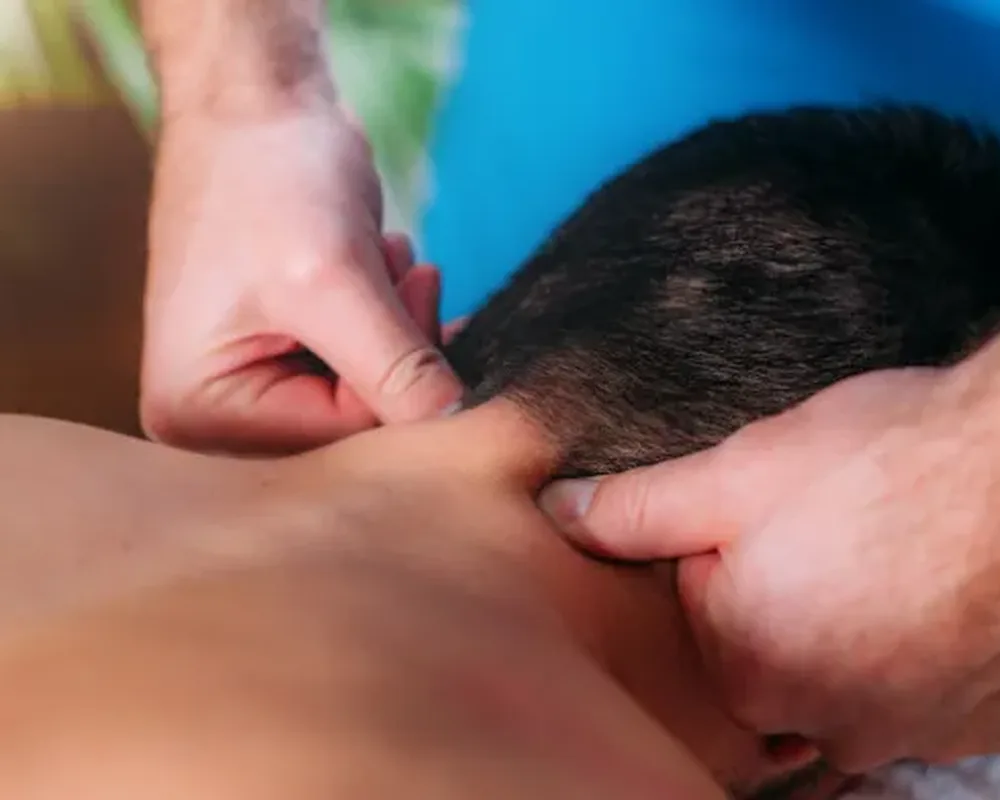
Most of what brings people in isn’t a diagnosis, it’s a sentence: the stairs that suddenly need a handrail, the arm you’ve started favoring without quite noticing when it started. Below are the conditions we see most often in Greer, each with what it usually turns out to be and the plain-language version of how we treat it.
None of this replaces your evaluation, and none of it is a diagnosis; it’s context, so you’re not walking in blind. What it usually is for someone with your symptom isn’t always what it is for you, which is exactly why the evaluation exists: to test, not guess, and to find the actual cause instead of treating the spot that hurts because that’s the spot that’s loudest.
The one thing every condition below has in common is what happens if it’s left alone too long. Pain that gets ignored doesn’t usually stay the same size; the shoulder you stopped reaching overhead with quietly teaches the rest of your body to compensate, and the compensation is its own problem by the time you finally call. A knee that’s been favored for a year has usually recruited the hip and the opposite ankle into the problem by the time anyone books an evaluation. Earlier is easier, almost every time we’ve seen it, and none of the conditions below require imaging or a referral to start sorting out.
The conditions, in your words.
Each one opens with the sentence we actually hear on the phone.
-
UsuallyNeck strain or stiff joints, often tied to how you sit or sleep. Common, mapped, and treatable in a predictable order.
Neck pain ⟶ -
UsuallyOften a headache that starts in the neck, not the head. If it’s something else entirely, we’ll say so and point you to the right provider.
Headaches ⟶ -
UsuallyRotator cuff irritation or a shoulder that’s stiffened up, the catch that shows up the moment you lift overhead.
Shoulder pain ⟶ -
UsuallyTennis elbow, carpal-tunnel-type symptoms, or desk strain that compounds all week. Grip returns once the cause, not the hand, is treated.
Elbow, wrist & hand pain ⟶ -
UsuallyLow back pain, a disc that’s flaring, or sciatica running down the leg. One of the most treatable things we see.
Back pain & sciatica ⟶ -
UsuallyHip bursitis, labral irritation, or a knee that votes against every squat. The two joints are mechanically linked, which is often why both are loud.
Hip & knee pain ⟶ -
UsuallyPlantar fasciitis, Achilles tendinitis, or an old sprain that never finished healing.
Foot & ankle pain ⟶ -
UsuallyOsteoarthritis, usually. Load managed the right way, not rested into more stiffness.
Arthritis ⟶ -
UsuallyBalance or gait issues from strength, proprioception, or the inner ear. Testable, and rarely fixed by simply “being more careful.”
Balance & gait disorders ⟶ -
UsuallyOveruse in the shoulder or elbow from throwing load outpacing recovery. Return-to-throw has a real progression, not a guess.
Baseball & throwing injuries ⟶ -
UsuallyPain that’s outlasted normal healing time. A cause-first evaluation looks for what’s actually still driving it.
Chronic pain ⟶ -
UsuallyOften a vestibular issue we can test and treat directly. If it’s something else, we’ll refer you to who can help.
Dizziness & vertigo ⟶ -
UsuallyWidespread pain sensitization. Graded movement, paced correctly, tends to help more than rest.
Fibromyalgia ⟶ -
UsuallySwing mechanics, rotation limits, or overuse from repetition. Return-to-golf is a real progression, not just rest.
Golfing injuries ⟶ -
UsuallyWhiplash and soft-tissue injury, which often shows up late. Common, and worth documenting properly from the start.
Motor vehicle accident injuries ⟶ -
UsuallyA pelvic floor issue, often after childbirth or with age. Evaluated respectfully, and more treatable than most people assume.
Pelvic organ prolapse ⟶ -
UsuallyPregnancy-related pelvic or back pain, or a postpartum core and pelvic floor that hasn’t fully reconnected yet.
Pre/postnatal pain ⟶ -
UsuallyOveruse injuries like IT band syndrome, shin splints, or runner’s knee, usually tied to load or mechanics.
Running injuries ⟶ -
UsuallySprains and strains with a real return-to-play standard to clear, not just a date on the calendar.
Sports injuries ⟶ -
UsuallyJaw joint dysfunction, often tied to the neck. Manual treatment can address both at once.
TMJ/TMD ⟶
Not sure what you have.
That’s the more common starting point, honestly. Most people who call don’t have a name for what’s wrong, they have a sentence about what it’s stopped them from doing: the walk they cut short, the workout they’ve quietly avoided for a month. That sentence is enough.
It’s more than enough, in fact, it’s exactly what a cause-first evaluation is built to take from vague to specific, with a Doctor of Physical Therapy one-on-one for the full hour, not a rushed guess based on where you’re pointing.
If you’d rather test your own instinct first, talk to a specialist ⟶ and walk through what you can’t do right now and what you want back, in plain language, no clinical terms required. Either way, the next step is the same: talk to a specialist and describe it in your own words. We’ll tell you what it usually is, what we’d test for, and what the plan would look like, before you commit to anything.
Put it in writing.
Five short questions. A real person calls you back, usually within two business hours, with times that fit your week.
The people who end up filling this out are rarely in the worst pain of their life. They’re just done working around it, done picking the errand that doesn’t require the stairs. If that’s the stage you’re at, this is the part where you stop researching and start.
Consider it filed.
A real person will call you back, usually within two business hours, with appointment times that fit your week. Keep your phone nearby.
Can’t wait? Call (864) 263-7390 ⟶Easy to find. Easy to park.
In the neighborhood, with parking by the door. Come see the place before you commit, if you like.
The clinic · Zone Physical Therapy
Get Directions ⟶Opens in Google Maps