

Greer, SC · What we treat
Sports injuries in Greer.
A rolled ankle, a pulled hamstring, a shoulder that hasn’t felt right since the collision at practice: a cause-first evaluation finds exactly what’s injured and how severely, then a plan with an endpoint gets you back on the field cleared by standards, not by the calendar.
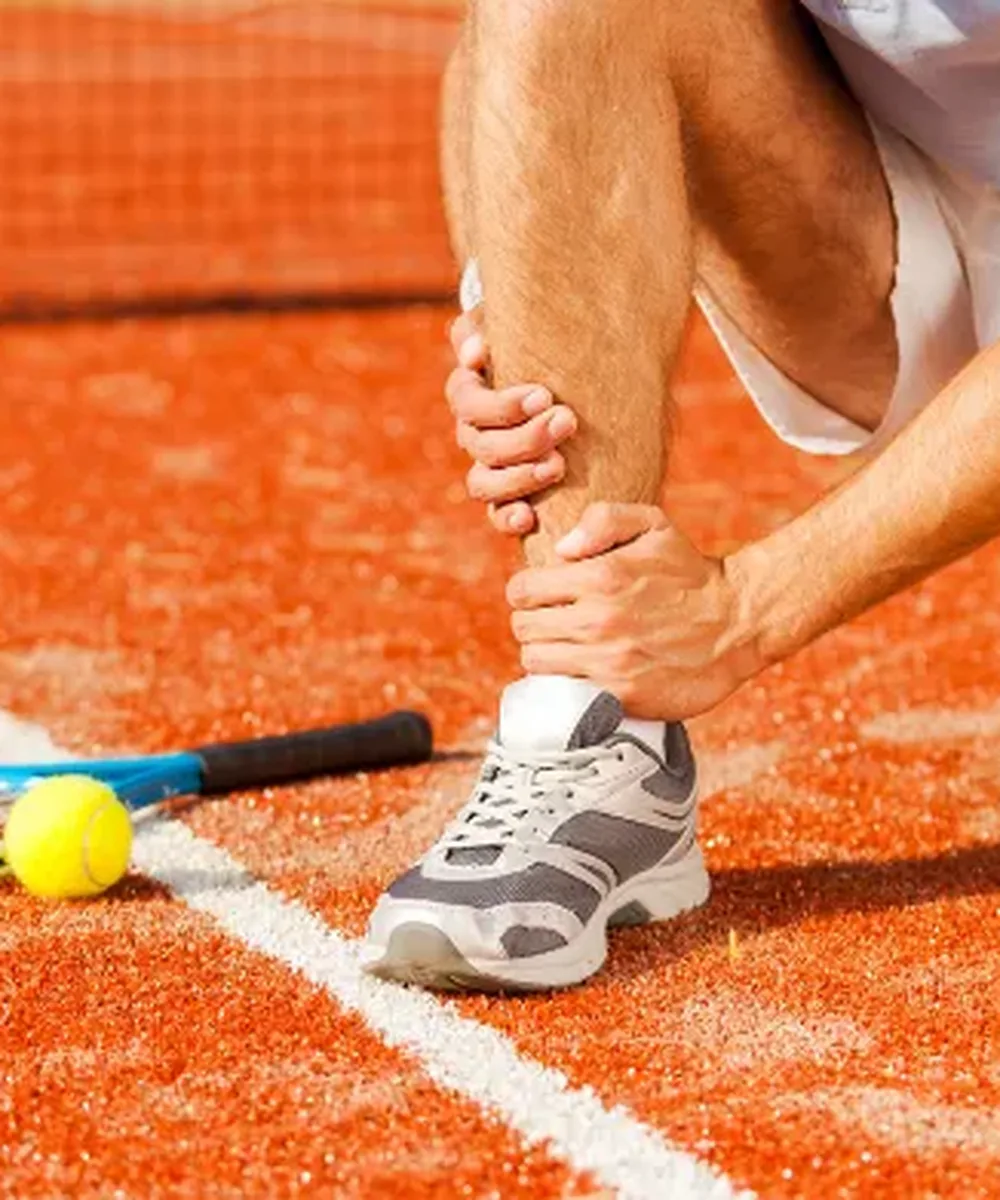
You’ve probably said one of these.
Nobody walks in describing a grade-two ligament sprain they haven’t had assessed. They describe days like these. Tap one that sounds like your week.
-
UsuallyAn ankle ligament sprain, with swelling and tenderness that track roughly with how much the ligament was stressed.
See how the plan rebuilds ankle stability ⟶ -
OftenA hamstring strain, a muscle or tendon tear that ranges from mild to significant depending on how it responds to loading.
See how strength testing tracks your recovery ⟶ -
UsuallyA completely fair worry. Return-to-play should be decided by objective testing standards, not a calendar deadline alone.
See how return-to-play testing works ⟶
- “It felt fine warming up, then it tightened right back up in the second half.”
- “I can walk on it fine, I just can’t cut or plant on it yet.”
- “The trainer taped it for the season, but it never actually got better.”
If two or three of those sound like your week, you’re not being overly cautious, and you’re not being dramatic either. You’re describing a pattern we see often, and one an evaluation is built to explain.
Why do sports injuries happen?
There’s rarely one single cause, across every sport we see. What we usually find, alone or in combination:
- Sudden deceleration or change of direction. Cutting, pivoting, and quick stops load ligaments and tendons in ways straight-line movement doesn’t.
- Contact injuries. Collisions and direct impact that strain or tear structures regardless of how well-conditioned the athlete is.
- Fatigue late in games or seasons. Tired muscles react slower and absorb load less efficiently, which is why injury rates often climb in the fourth quarter or late season.
- Strength or mobility asymmetries. A weaker or tighter side that hasn’t been addressed, quietly raising injury risk on that limb.
- Returning to play before tissue was ready. Going back on a calendar timeline rather than a tested one, which is one of the more common reasons the same injury recurs.
None of these are things a trainer’s tape job resolves on its own, and most don’t require imaging to start treating. That’s what the evaluation sorts out.
How do we treat sports injuries in Greer?
Treatment starts with a cause-first evaluation: testing joint stability, strength, and the specific movements your sport demands, so return-to-play is based on standards, not on how many weeks have passed. From there, care moves through four named phases.
The plan’s endpoint, and the clearance criteria to get there, are named at your evaluation and reviewed with you every phase.
Protect and calm it.
Controlling swelling and pain while protecting the injured structure appropriately, starting the first visit rather than waiting on rest alone.
Restore the basics.
Rebuilding full pain-free range of motion and baseline strength before any sport-specific loading resumes.
Build sport-specific power.
Strength, agility, and power testing against your sport’s demands, comparing your injured side to your healthy side before you progress.
Clear you to play.
Formal return-to-play testing against clearance criteria, plus injury-prevention programming specific to your sport’s common injury patterns.
What does getting better look like?
Athletes who end up booking an evaluation are rarely the ones who sat out immediately. More often, it’s someone who played through the rest of the game or the week, iced it, taped it, and hoped it would settle before the next big matchup. If that’s closer to your version, you’re the typical patient here, not someone who ignored an obvious red flag.
Progress tends to show up in ordinary places first: cutting at full speed without hesitation, sprinting without that guarded half-effort, a landing that doesn’t make you brace. Left unaddressed or rushed back too soon, sports injuries have a well-documented tendency to recur, often worse the second time, because the underlying strength or stability deficit never got fixed the first time.
An evaluation turns “is it ready” into a plan with tested clearance criteria, reviewed with you at every phase.
Which services treat sports injuries?
Physical Therapy
The foundation of treatment: the cause-first evaluation and the four-phase plan that runs the whole recovery.
02Sports Rehab
Return-to-play testing and sport-specific progressions for injuries across every level of competition.
03Sports Performance
Carries Phase IV forward, building the power and mechanics that reduce reinjury risk once you’re cleared.
04Blood Flow Restriction
Builds strength with lighter loads early in recovery, useful when heavier loading isn’t appropriate yet.
“Scott has made it possible for me to get back on the ice with no pain and be ready for my college season.”Hailey Anderson · Zone PT patient
Questions, answered plainly.
The things athletes and parents ask on the phone, written down.
Sprains involve a ligament, strains involve a muscle or tendon, and both can range from mild to significant, which is exactly why the severity matters more than the label. The evaluation tests joint stability, strength, and swelling patterns to sort out which structure is involved and how serious it is. If something looks like it needs imaging or a physician’s opinion, we’ll say so and refer you there directly.
Ready means clearing specific strength, movement, and sport-specific testing standards, not just a number of weeks passing or the pain going away at rest. We test for that directly, comparing your injured side to your healthy side and to benchmarks for your sport, so the clearance is based on what your body can actually handle again.
Often not right away. Most sprains and strains can be evaluated and treatment can begin based on movement, strength, and stability testing, without waiting on a scan. If your exam findings suggest a more significant injury that imaging should confirm, we’ll refer you for that promptly rather than guessing.
Yes. Once you’re cleared from the injury itself, the same evaluation that found your limitation often reveals a strength or movement asymmetry worth addressing beyond simply returning to your prior level. Many athletes use the Prevent phase to build strength and mechanics that reduce reinjury risk and support performance in their sport.
Start with a cause-first evaluation for your sports injury.
Put it in writing.
Five short questions. A real person calls you back, usually within two business hours, with times that fit your week.
The people who end up filling this out are rarely in the worst pain of their life. They’re just done working around it, done picking the errand that doesn’t require the stairs. If that’s the stage you’re at, this is the part where you stop researching and start.
Consider it filed.
A real person will call you back, usually within two business hours, with appointment times that fit your week. Keep your phone nearby.
Can’t wait? Call (864) 263-7390 ⟶Easy to find. Easy to park.
In the neighborhood, with parking by the door. Come see the place before you commit, if you like.
The clinic · Zone Physical Therapy
Get Directions ⟶Opens in Google Maps