

Greer, SC · Services
Blood flow restriction training in Greer.
Low-load, high-effect strength work for the phase where heavy loading isn’t cleared yet but the muscle loss is real, monitored and dosed by a Doctor of Physical Therapy the whole way.
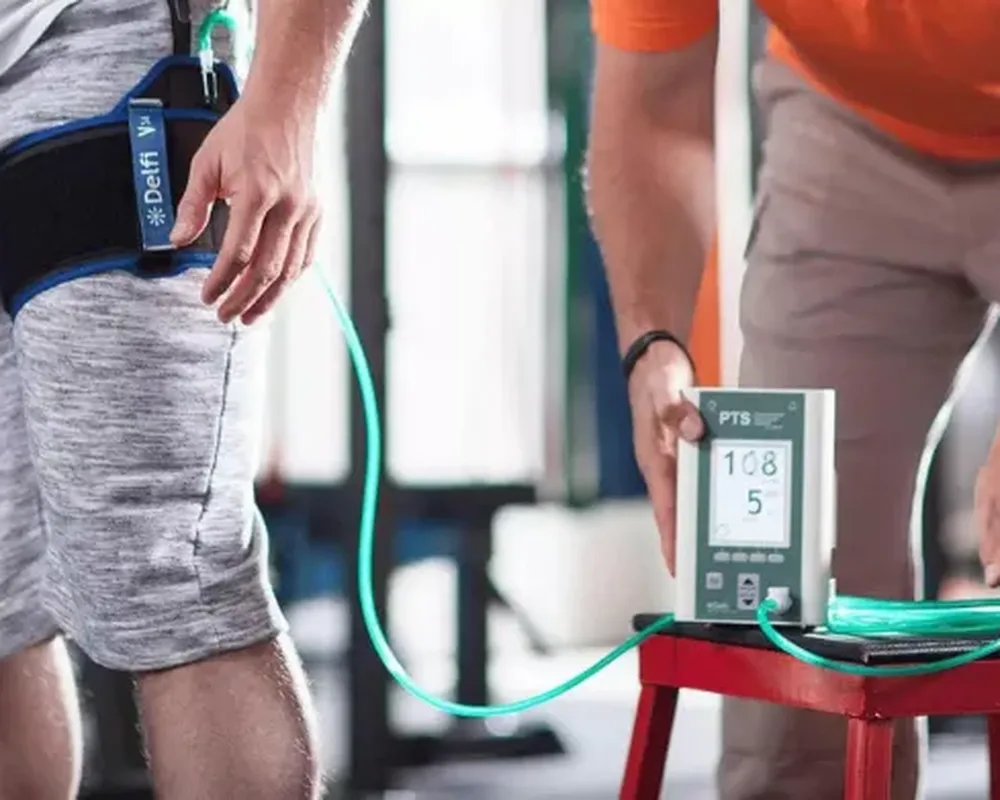
What is blood flow restriction training in Greer?
Blood flow restriction, BFR, uses a calibrated cuff to partially restrict venous return from a limb while you exercise it at a low load, usually 20 to 30 percent of what you could normally lift. That restriction creates a metabolic environment similar to heavy lifting, so the muscle responds like it’s been loaded hard, without the joint or the healing tissue taking the mechanical stress that comes with actual heavy weight.
It exists for a specific gap: the stretch of recovery where a joint or a healing tissue can’t yet tolerate the load your muscle needs to rebuild strength. Without it, that gap is usually where strength loss compounds, quietly, while you wait to be cleared for real weight.
Every plan runs through the same four phases, Pain, Prime, Perform, and Prevent, with BFR doing its heaviest lifting, so to speak, in the early phases before you’re progressed to traditional loading.
Protect what’s healing.
BFR lets muscle work start early, before the joint or tissue is cleared for real load.
Rebuild the muscle.
Low-load sets dosed against your calculated pressure, tracked for real strength return.
Bridge to real load.
A gradual handoff from BFR to traditional strengthening as the joint clears each standard.
Confirm it holds.
Strength testing against your uninjured side before you’re cleared for full training.
What does blood flow restriction training address?
It’s most useful wherever strength loss and load restriction happen at the same time. A sample of what it commonly supports:
Hip & knee pain ⟶
Post-surgical or arthritic joints that can’t yet tolerate heavy loading but need the muscle around them rebuilt.
02Sports injuries ⟶
Tendon and ligament injuries where early strength work speeds recovery without overloading the repair.
Muscle that goes unloaded for weeks doesn’t wait patiently. It atrophies fast, and the longer that goes unaddressed, the longer the road back to full strength once you’re finally cleared.
What does a BFR session look like?
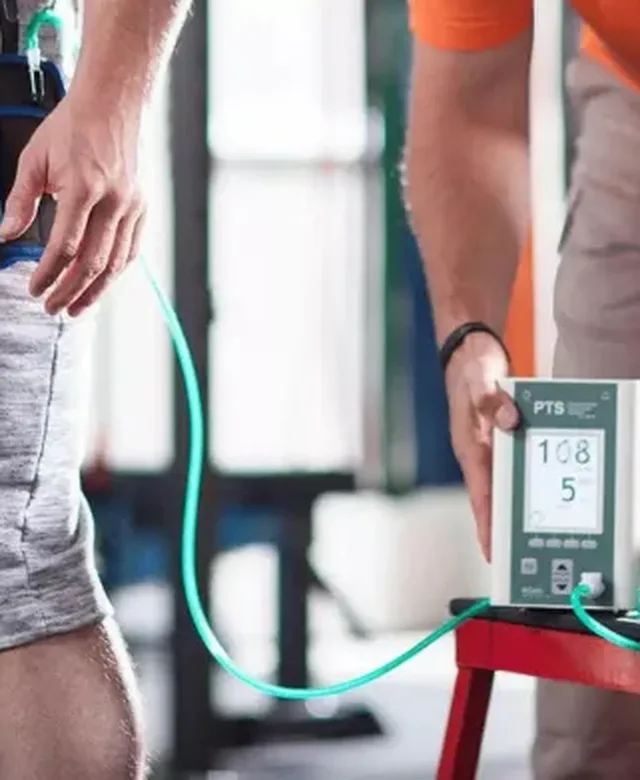
The cuff is placed on the limb being trained and calibrated to a percentage of your limb’s occlusion pressure, a number specific to you, not a generic setting. Blood pressure and vascular history are screened before your first session so we know it’s appropriate for you.
You’ll work through several sets of low-load exercise, usually bodyweight or light resistance, with brief rests between. It feels like a real workout, a deep, honest fatigue, even though the weight itself is light. Your Doctor of Physical Therapy stays with you the entire time, adjusting pressure and load as your tolerance builds.
Who this is for, and who it isn’t.
This fits anyone caught between an injury and the weight room: recovering from surgery where heavy loading isn’t cleared yet, managing a tendon or bone stress issue as an athlete, or simply plateaued on traditional strengthening and looking for more training effect with less joint stress.
If waiting to be cleared for heavy weight feels like watching strength disappear, this is the tool built for exactly that window.
It’s not appropriate for uncontrolled blood pressure, certain vascular conditions, or a history of blood clots, all screened before your first session. It's also not needed if you’re already cleared for and tolerating heavy loading; BFR is a bridge, not an upgrade.
Good fit
- Recovering from surgery where heavy loading isn’t cleared yet, but strength loss is real
- Managing a tendon or bone stress issue as an athlete who still wants a training effect
- A joint that can’t yet tolerate the load the muscle needs to rebuild strength
- Plateaued on traditional strengthening and want more from less joint stress
Not the right first stop
- Uncontrolled blood pressure, certain vascular conditions, or a history of blood clots
- Already cleared for and tolerating heavy loading; BFR is a bridge, not an upgrade
BFR closes the gap. Sports performance is what you build once it's closed.
“Scott and his team are top notch physical therapists and really helped me out tremendously in my recent marathon build.”David Smith · Zone PT patient
Questions, answered plainly.
Yes, when it’s screened and monitored properly. We check blood pressure and vascular history before starting, use a calibrated cuff set to a percentage of your limb’s occlusion pressure, and stay in the room with you for the entire set. It’s a well-studied technique, not an experimental one.
It’s built for the gap between an injury and a heavy weight room: post-surgical patients not yet cleared for load, athletes managing a tendon or bone stress issue, or anyone whose joint can’t tolerate the load their muscle needs to rebuild strength.
Yes. Restricting venous return during low-load exercise creates a metabolic and hormonal environment similar to heavy lifting, so you get a comparable strength and hypertrophy effect at a fraction of the mechanical stress on the joint or the healing tissue.
The cuff goes on the limb being trained, set to your calculated pressure, then you work through a set of low-load exercises, usually bodyweight or light resistance, for a set number of reps. The whole session runs about 45 minutes, and your Doctor of Physical Therapy stays with you throughout.
Don’t lose ground waiting to be cleared.
Put it in writing.
Five short questions. A real person calls you back, usually within two business hours, with times that fit your week.
The people who end up filling this out are rarely in the worst pain of their life. They’re just done working around it, done picking the errand that doesn’t require the stairs. If that’s the stage you’re at, this is the part where you stop researching and start.
Consider it filed.
A real person will call you back, usually within two business hours, with appointment times that fit your week. Keep your phone nearby.
Can’t wait? Call (864) 263-7390 ⟶Easy to find. Easy to park.
In the neighborhood, with parking by the door. Come see the place before you commit, if you like.
The clinic · Zone Physical Therapy
Get Directions ⟶Opens in Google Maps