

Greer, SC · What we treat
Fibromyalgia in Greer.
Widespread pain that doesn’t match anything a scan can show, and good days that don’t always look different from bad ones: a cause-first evaluation finds your actual movement tolerance, then a plan with an endpoint builds it up gradually, with pacing that’s realistic instead of a push-through-it approach that tends to backfire.
You’ve probably said one of these.
Nobody walks in describing fibromyalgia in medical terms they picked up on their own. They describe days like these. Tap one that sounds like yours.
-
UsuallyThe invisible variability of fibromyalgia, where pain and fatigue fluctuate independent of visible activity or effort.
See why fibromyalgia varies this much ⟶ -
OftenThe push-crash cycle, overexertion on a lower-pain day triggering a flare, which graded pacing is specifically built to prevent.
See how pacing replaces the push-crash cycle ⟶ -
UsuallyWidespread pain sensitization, a nervous system amplifying normal input rather than a problem in the tissue itself.
See how manual therapy is dosed for this ⟶
- “I plan my errands around which day I’ll have enough energy to shower after.”
- “I’ve learned to say ‘I’m tired’ instead of explaining what the fatigue actually feels like.”
- “Cold rooms and long days both seem to turn the volume up on everything.”
If two or three of those sound like your week, you’re not imagining the inconsistency. You’re describing a pattern we see often, and one an evaluation is built to work with.
Why does fibromyalgia happen?
There’s rarely one single cause, which is exactly why guessing doesn’t work. What we usually find, alone or in combination:
- Central sensitization. A nervous system that’s become more reactive over time, processing normal sensory input, touch, pressure, temperature, as pain.
- Sleep disruption. Poor or non-restorative sleep that’s common in fibromyalgia and tends to worsen next-day pain and fatigue in a compounding cycle.
- The push-crash pattern. Doing more on a lower-pain day, followed by a flare that forces days of reduced activity, a cycle graded pacing is specifically built to interrupt.
- Deconditioning from flare avoidance. Muscles and joints that quietly weaken from months of activity avoidance, which paradoxically makes ordinary movement feel harder over time.
- Stress and nervous system load. Physical and emotional stress that can measurably raise pain sensitivity, separate from any new tissue injury.
None of these are diagnoses you make yourself, and most don’t require imaging to start treating. That’s what the evaluation sorts out.
How do we treat fibromyalgia in Greer?
Treatment starts with a cause-first evaluation: establishing your actual baseline for movement and load, honestly, without assuming what you should be able to do. From there, care moves through four named phases.
The plan’s endpoint is named at your evaluation, reviewed with you every phase, because the goal is widening what a good day includes, not keeping you on the schedule.
Find your current tolerance, honestly.
A cause-first evaluation that establishes your actual baseline for movement and load, without assuming what you should be able to do.
Introduce movement below the flare line.
Gentle, graded activity dosed below the threshold that provokes a crash, building tolerance gradually rather than testing limits.
Expand what a good day can include.
Progressive strengthening and conditioning, paced against your response rather than a fixed schedule, so capacity grows without repeated setbacks.
Build a pacing strategy you can actually keep.
A personalized plan for balancing activity and rest day to day, plus a clear strategy for managing a flare without losing months of progress.
What does getting better look like?
People who book an evaluation for fibromyalgia have usually already been told to push through it, or, just as often, to rest completely, and found both approaches made things worse in different ways. If that’s closer to your version, you’re the typical patient here, not a difficult one.
Progress here rarely means the pain disappearing. It tends to look like fewer flare days each month, a slightly higher baseline for what a normal day includes, and recovering from a flare in two days instead of five. Left untreated, the push-crash cycle rarely resolves on its own; it tends to narrow activity further over time, as each crash makes the next flare-up feel more likely.
Fibromyalgia isn’t cured by any single plan. But pacing and graded movement genuinely widen what a good day looks like, and that is real progress, even without a finish line.
Which services treat fibromyalgia?
Physical Therapy
The foundation of treatment: the cause-first evaluation and the four-phase plan that runs the whole recovery.
02Therapeutic Exercise
Graded, low-load movement dosed below your flare threshold, the core of building tolerance safely.
03Myofascial Release
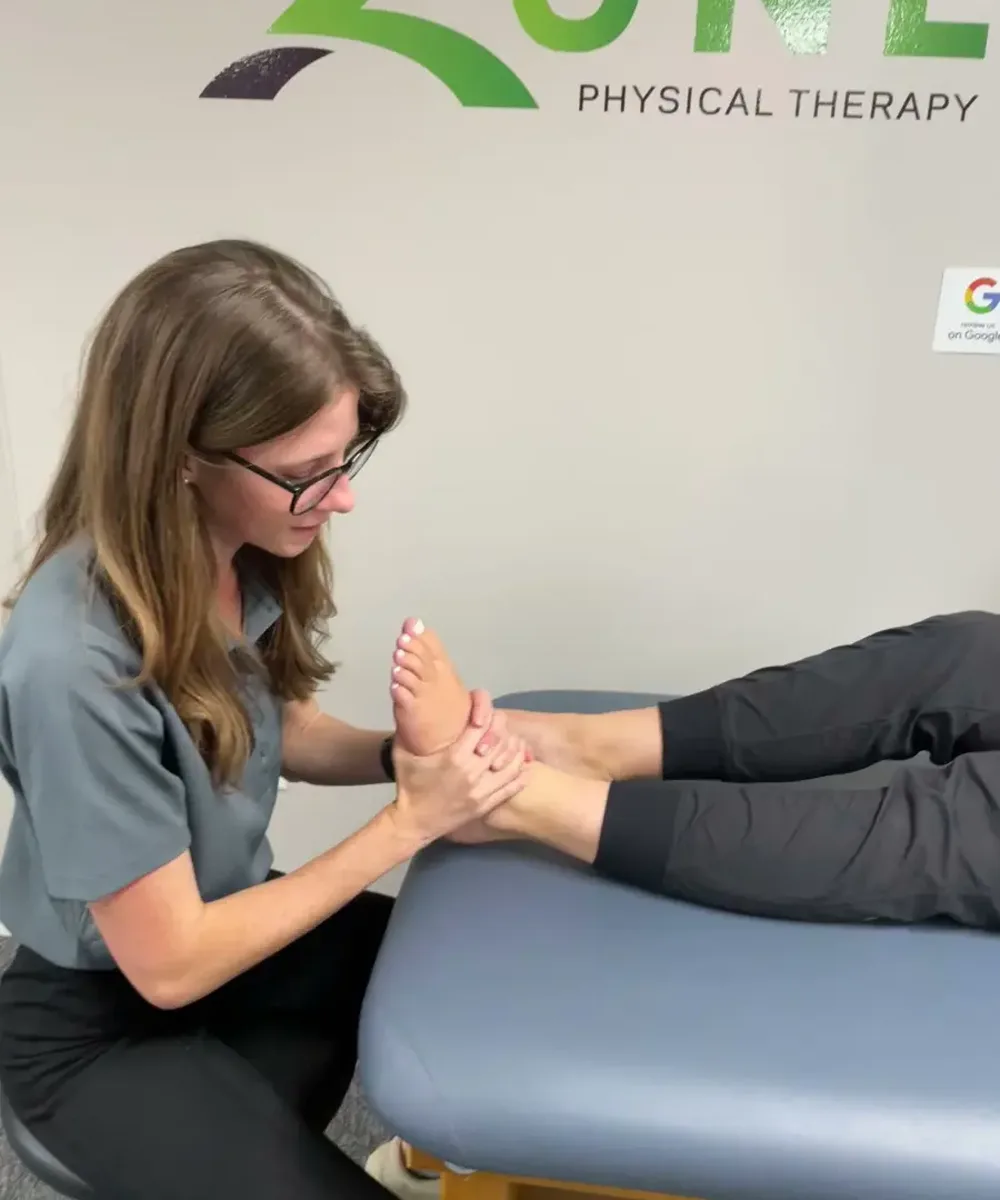
Gentle hands-on treatment for widespread tenderness, dosed carefully to your sensitivity that day.
04Manual Therapy
Light-touch, sensitivity-aware treatment for specific areas of tightness or tenderness.
“Scott and his team do an amazing job! The team at Zone is amazing at taking the time to work with you and giving you a plan to recover.”Marshall McCall · Zone PT patient
Questions, answered plainly.
The things people ask on the phone about fibromyalgia, written down.
It is more than coping. Graded, well-dosed movement is one of the better-supported treatments for fibromyalgia, and most patients see real gains in tolerance, function, and flare frequency over time, not just strategies for living around the pain. It will not cure the underlying sensitization, but it changes how much of your life the condition gets to limit.
Too much, too soon usually does, which is exactly why the plan starts below your flare threshold rather than at a generic starting point. Movement dosed correctly tends to reduce sensitivity over time rather than increase it; the skill is in the pacing, not in avoiding movement altogether.
Sessions are built around your current tolerance that day, which fibromyalgia makes variable, so expect some flexibility rather than a fixed routine regardless of how you're feeling. Manual therapy, low-load strengthening, and pacing education are common components, adjusted visit to visit based on how your body is responding.
Your plan includes a specific flare strategy: which activities to scale back temporarily, which to keep, and how to return to your baseline without losing the progress you've built. The goal is riding out a flare in days rather than weeks, and not treating every flare as a reason to start over.
Start with a cause-first evaluation for your fibromyalgia.
Put it in writing.
Five short questions. A real person calls you back, usually within two business hours, with times that fit your week.
The people who end up filling this out are rarely in the worst pain of their life. They’re just done working around it, done picking the errand that doesn’t require the stairs. If that’s the stage you’re at, this is the part where you stop researching and start.
Consider it filed.
A real person will call you back, usually within two business hours, with appointment times that fit your week. Keep your phone nearby.
Can’t wait? Call (864) 263-7390 ⟶Easy to find. Easy to park.
In the neighborhood, with parking by the door. Come see the place before you commit, if you like.
The clinic · Zone Physical Therapy
Get Directions ⟶Opens in Google Maps