

Greer, SC · Services
Therapeutic exercise in Greer.
Guided, progressive exercise built around the specific deficit a cause-first evaluation finds, for chronic pain, limited mobility, and the injury that keeps coming back.
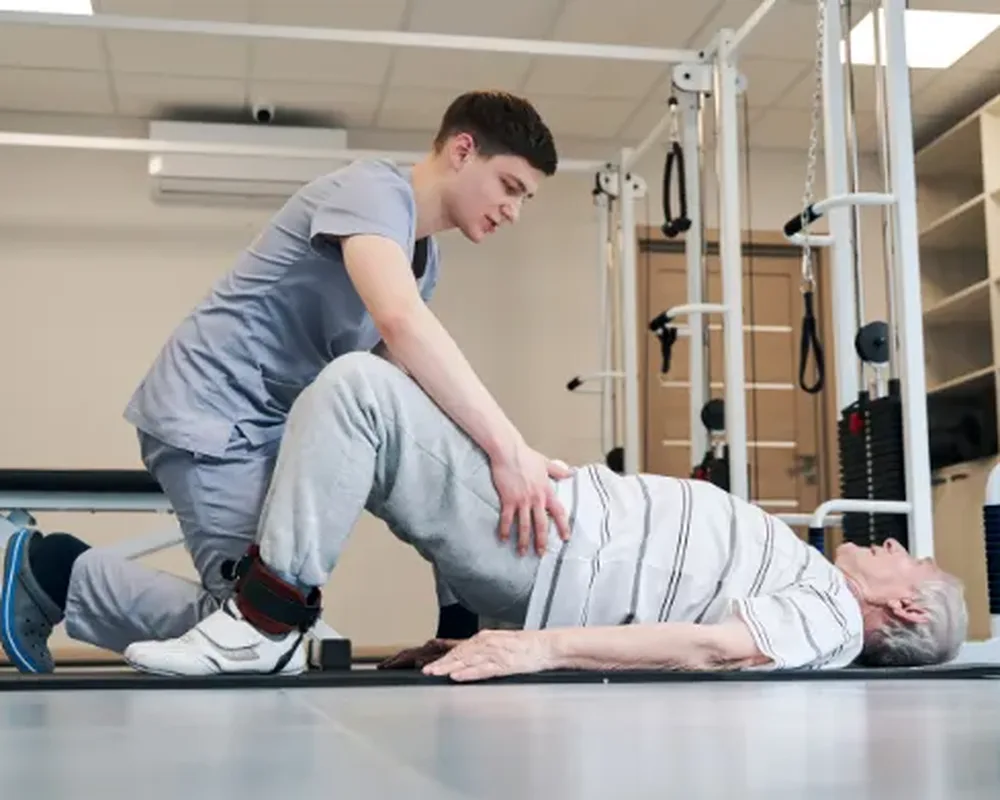
What is therapeutic exercise in Greer?
Therapeutic exercise is guided, progressive exercise prescribed to a specific deficit found in a cause-first evaluation, a weak hip, a limited joint, a movement pattern feeding a chronic ache, not a general workout handed to everyone who walks in. The evaluation identifies exactly what’s missing before a single exercise is chosen.
From there, every visit is one-on-one with a Doctor of Physical Therapy, for the full hour. Care moves through four named phases, Pain, Prime, Perform, and Prevent, in that order: managing the flare, restoring basic mobility and strength, progressively loading to a real standard, and building a durable program you keep once you graduate.
And the plan has a named endpoint, defined at your evaluation, because the goal is a body that holds up on its own, not a routine you depend on indefinitely.
Calm it down.
Hands-on treatment begins at the first visit. You leave understanding what’s actually going on, and you feel a difference early.
Restore what’s stuck.
Targeted mobility work for the joints and tissue actually holding you back, dosed to your body, not a printed sheet.
Build strength you trust.
Progressive load against standards you have to clear before moving on. Confidence, here, is a training effect.
Make it stay fixed.
Testing before you’re cleared, then a keep-it-gone program sized to your real week. Then we graduate you.
What conditions does therapeutic exercise treat?
Therapeutic exercise tends to get called in when pain or limitation has been managed rather than resolved. A sample of what it commonly addresses:
Chronic pain ⟶
The pain that’s been managed, not solved, for longer than anyone’s comfortable admitting.
02Arthritis ⟶
The joint that’s stiffest first thing in the morning and loosens, some, by midday.
03Hip & knee pain ⟶
The stairs, the floor, and the getting up from it, all quietly harder than they used to be.
Rest alone rarely resolves a deficit; it just gives it somewhere quiet to persist. Loaded, progressive exercise, dosed to what a joint or muscle can actually handle, is usually what turns “managed” into “resolved.”
What does a therapeutic exercise session look like?
The evaluation tests strength, mobility, and movement quality against the specific deficit driving your pain, then the first exercises are chosen and started the same hour. You leave with a plan, not a printed sheet you’re expected to figure out at home alone.
Every visit after builds on the last: a check-in on how the exercises felt, then progressively loaded work, tested against a standard before you advance to more weight, more range, or more complexity. Your doctor stays with you the whole hour, coaching form and adjusting dosage in real time.

Who this is for, and who it isn’t.
Therapeutic exercise tends to fit anyone whose pain has been managed rather than resolved, chronic pain that’s become routine, arthritis limiting daily function, or an injury that keeps recurring no matter how much rest it gets. You don’t need a referral to start, and you don’t need to already know which deficit is driving it.
The patients who choose this are usually the same type: they’re tired of managing something instead of fixing it, and they want a plan built to a standard, not a sheet of exercises to figure out alone. If that’s you, you’re the right patient for this room.
It’s not the right first stop for a medical emergency or an undiagnosed condition that needs imaging before exercise is safe. In those cases, get evaluated medically first, then come see us for the exercise progression that follows.
Good fit
- Chronic pain that’s been managed rather than resolved
- Arthritis or stiffness limiting daily function
- An injury that keeps recurring no matter how much rest it gets
- No referral required, and no need to already know the deficit
Not the right first stop
- A medical emergency
- An undiagnosed condition that needs imaging before exercise is safe
Orthopedic therapy ⟶
For the joint-specific mechanical issue the exercise work is built around.
02PRI therapy ⟶
For the whole-body asymmetry pattern a single-joint exercise plan alone won’t fully address.
Most durable results come from pairing at least one of these with the exercise progression itself.
“I had lower back pain after standing so I came to visit Dr. Scott. After six sessions I feel my hips leveled and I feel stronger.”M. I. · Zone PT patient
Questions, answered plainly.
The moves can look similar; the reasoning behind them isn’t. Every exercise is chosen because your evaluation found a specific deficit, a weak hip, limited ankle mobility, poor movement control, that a general workout wouldn’t target directly. Dosage, order, and progression are built around your evaluation, not a class format or a printed sheet everyone gets.
It’s aimed at more than management. Chronic pain often persists because a movement pattern, a strength deficit, or a joint restriction keeps feeding it, and that’s exactly what a cause-first evaluation looks for. Therapeutic exercise addresses that underlying driver directly, which is why it can change the pain itself, not just distract from it for an hour.
That pattern usually means the actual cause was never addressed, only the symptom. A recurring injury is one of the clearest signals that something upstream, strength, mobility, movement mechanics, needs to change, not just rest again until it flares next time. The evaluation is built to find that pattern.
No. Most programs start with bodyweight and basic equipment already in the clinic, and progress from there based on how you respond, not a preset gym routine. You don’t need prior experience; you need an evaluation that tells your Doctor of Physical Therapy where to start.
Start with the evaluation that finds the actual deficit.
Put it in writing.
Five short questions. A real person calls you back, usually within two business hours, with times that fit your week.
The people who end up filling this out are rarely in the worst pain of their life. They’re just done working around it, done picking the errand that doesn’t require the stairs. If that’s the stage you’re at, this is the part where you stop researching and start.
Consider it filed.
A real person will call you back, usually within two business hours, with appointment times that fit your week. Keep your phone nearby.
Can’t wait? Call (864) 263-7390 ⟶Easy to find. Easy to park.
In the neighborhood, with parking by the door. Come see the place before you commit, if you like.
The clinic · Zone Physical Therapy
Get Directions ⟶Opens in Google Maps