
Greer, SC · Services
Electrical stimulation in Greer.
A controlled current, placed exactly where your evaluation says it should go, to calm pain that’s in the way or wake up a muscle that’s stopped doing its job. A tool inside your plan, dosed to what you actually need.
What is electrical stimulation in Greer?
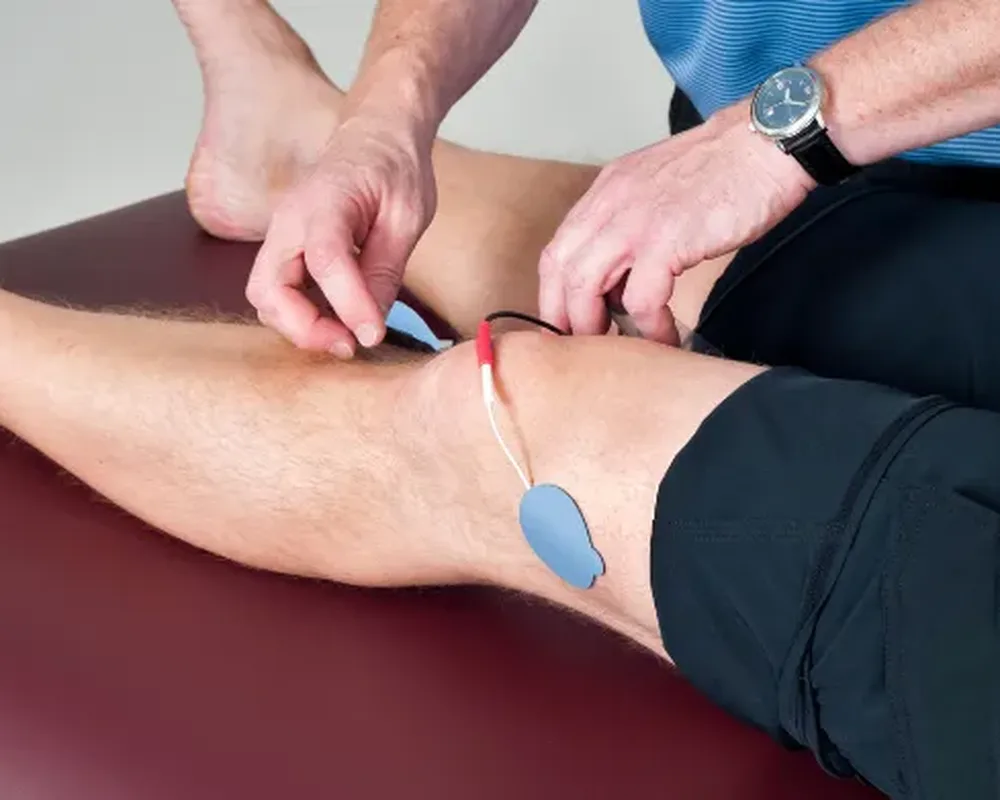
Electrical stimulation sends a low-level, controlled current through electrodes placed on the skin, and what that current does depends entirely on the setting. One mode helps quiet pain signals so you can tolerate hands-on treatment and movement work. A different mode, used after surgery or a significant injury, recruits a muscle that’s gone quiet and reminds it how to contract on its own.
The setting and the placement both come from your evaluation, not a default protocol run on everyone who walks in. A quad that shut off after knee surgery gets treated differently than a low back that’s simply too irritated to move well yet, even though both might involve the same machine.
Like most tools here, it works inside the four-phase plan, Pain, Prime, Perform, and Prevent, most often earning its place early, when pain or muscle inhibition is the thing standing between you and the work that actually rebuilds you.
Calm it down.
Hands-on treatment begins at the first visit. You leave understanding what’s actually going on, and you feel a difference early.
Restore what’s stuck.
Targeted mobility work for the joints and tissue actually holding you back, dosed to your body, not a printed sheet.
Build strength you trust.
Progressive load against standards you have to clear before moving on. Confidence, here, is a training effect.
Make it stay fixed.
Testing before you’re cleared, then a keep-it-gone program sized to your real week. Then we graduate you.
What conditions does electrical stimulation treat?
Electrical stimulation tends to get called in when pain or a muscle that won’t engage is limiting activity on its own. A sample of what it commonly supports:
Back pain & sciatica ⟶
The spasm that locks up before you can even get to the stretching.
02Hip & knee pain ⟶
The quad that shut off after surgery and won’t hold a contraction on command.
03Sports injuries ⟶
The muscle inhibition that follows a sprain long after the swelling’s gone.
A muscle that stops firing correctly doesn’t just sit there waiting. Other muscles start covering for it, and the longer that compensation runs, the more it costs to unwind later.
What does an electrical stimulation session look like?
Electrodes go on over the muscle or area your evaluation identified, and the intensity builds gradually until it’s doing its job: a tingling calm for pain control, or a visible contraction for muscle re-education. You’ll feel it working, but it shouldn’t hurt, and we check in early to make sure the level is right for you.
It’s rarely the whole visit. Most sessions pair stimulation with the hands-on treatment or movement work it’s meant to support, either running at the same time or right before it, so the calmer, more responsive muscle gets put to use immediately instead of just resting.
Who this is for, and who it isn’t.
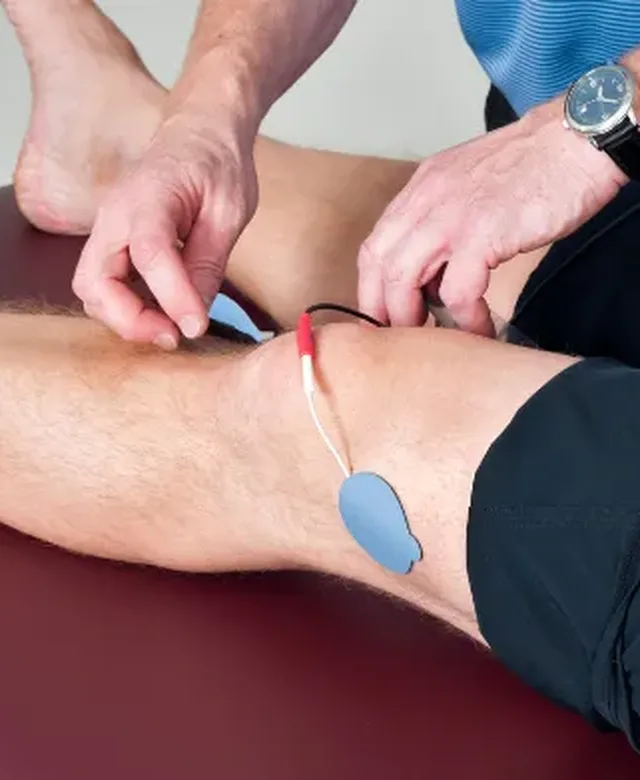
Electrical stimulation tends to fit two situations well: pain that’s intense enough to keep you from tolerating the hands-on or movement work you actually need, and a muscle that’s stopped engaging correctly after surgery or a significant injury, the kind that won’t hold a contraction no matter how hard you try to flex it.
The people who benefit most are usually the same type: stuck between the pain and the work that fixes the pain, or watching a muscle that used to respond simply refuse to. If that’s where you are, it’s worth raising at your evaluation.
It’s not appropriate for anyone with a pacemaker or other implanted electrical device, over the abdomen or pelvis during pregnancy, near an active blood clot, or over certain areas during active cancer treatment. That screening happens at your evaluation, before anything is scheduled.
Good fit
- Pain intense enough to block hands-on or movement work
- A muscle that’s stopped engaging after surgery or injury
- Part of an existing plan, dosed to a specific finding
Not the right fit
- A pacemaker or other implanted electrical device
- Pregnancy, over the abdomen or pelvis
- An active blood clot near the treatment area
- Certain areas during active cancer treatment (screened at evaluation)
It opens the door. The rest of the plan walks through it.
“You’ll never feel like you are just another number and getting processed through! Highly recommend to everyone!”Marshall McCall · Zone PT patient
Questions, answered plainly.
Most patients feel a tingling or tapping sensation, and at higher intensities a visible muscle contraction that feels unusual before it feels uncomfortable. We build the intensity up gradually and stop well short of pain. It shouldn’t hurt, and if it does, we turn it down.
It uses similar technology but not the same application. A home TENS unit is generally set to one pain-relief mode. In clinic, we choose from several stimulation types, including settings built to recruit a specific muscle that’s stopped firing correctly, and we place electrodes based on findings from your evaluation, not a generic pad placement.
It depends on why it’s in your plan. Used for pain control, it often runs for the first several visits of the Pain phase and tapers as you need it less. Used to re-activate a muscle after surgery or injury, it typically continues until that muscle can hold its own contraction reliably during strength testing.
Not in most cases, which is why we screen for pacemakers, other implanted electrical devices, pregnancy over the treatment area, active blood clots, and certain areas near cancer treatment before ever placing an electrode. That screening happens at your evaluation, before anything is scheduled.
Start with the evaluation that finds what’s actually quiet.
Put it in writing.
Five short questions. A real person calls you back, usually within two business hours, with times that fit your week.
The people who end up filling this out are rarely in the worst pain of their life. They’re just done working around it, done picking the errand that doesn’t require the stairs. If that’s the stage you’re at, this is the part where you stop researching and start.
Consider it filed.
A real person will call you back, usually within two business hours, with appointment times that fit your week. Keep your phone nearby.
Can’t wait? Call (864) 263-7390 ⟶Easy to find. Easy to park.
In the neighborhood, with parking by the door. Come see the place before you commit, if you like.
The clinic · Zone Physical Therapy
Get Directions ⟶Opens in Google Maps