

Greer, SC · Services
Custom orthotics in Greer.
Built from a real foot mechanics exam, not a kiosk scan: a correction sized to how your foot actually loads, for the ankle, knee, hip, back, or even shoulder pain that traces back to the ground up.
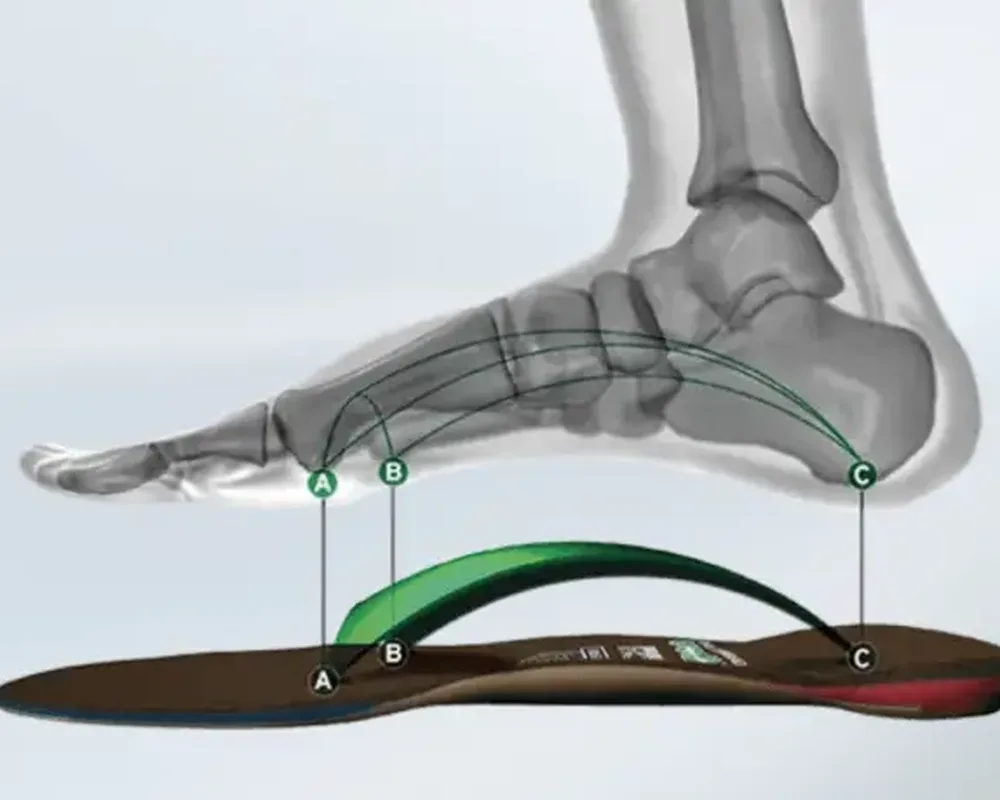
What are custom orthotics in Greer?
A surprising amount of recurring pain starts at the ground and travels up. A foot that rolls in too far, an arch that’s collapsed or too rigid, a limb-length difference you’ve never been told about: any of these can quietly overload the ankle, knee, hip, or low back with every single step, thousands of times a day, long before the pain ever announces itself.
A custom orthotic is built to correct that specific fault, not to cushion around it. Your evaluation includes a gait and foot mechanics exam, watching how you stand, walk, and load under weight, before we cast or scan your foot for a device shaped to your mechanics rather than a shoe size off a shelf.
Orthotics are a passive correction, which means they work best paired with active care. Inside the four-phase plan, Pain, Prime, Perform, and Prevent, they typically go to work early, taking load off an irritated joint while hands-on treatment and movement retraining address the muscles and mobility that let the fault develop in the first place.
Calm it down.
Hands-on treatment begins at the first visit. You leave understanding what’s actually going on, and you feel a difference early.
Restore what’s stuck.
Targeted mobility work for the joints and tissue actually holding you back, dosed to your body, not a printed sheet.
Build strength you trust.
Progressive load against standards you have to clear before moving on. Confidence, here, is a training effect.
Make it stay fixed.
Testing before you’re cleared, then a keep-it-gone program sized to your real week. Then we graduate you.
What conditions do custom orthotics treat?
Correcting foot mechanics tends to matter most when pain shows up somewhere other than the foot itself. A sample of what it commonly supports:
Foot & ankle pain ⟶
The arch that aches by afternoon and the first steps out of bed that hurt the most.
02Hip & knee pain ⟶
The inward collapse at the knee that’s never once been about the knee.
03Back pain & sciatica ⟶
The tilt in your stride that’s been quietly loading one side of your low back.
A foot mechanics fault rarely stays contained. Left uncorrected, it tends to widen its reach, recruiting the knee, then the hip, then the low back into compensating for a problem that started three joints away.
What does an orthotic fitting look like?
The exam comes first: a look at your standing posture, your walking pattern, and the way your foot moves under load, checked against the pain pattern you came in with. If an orthotic is the right tool, we take a mold or digital scan of your foot in a corrected, neutral position, not the collapsed one that’s been causing trouble.
The device is fabricated by an outside lab to that specific correction, then fitted at a follow-up visit. We check it in your actual shoes, walk you through a short break-in period, and adjust anything that rubs or doesn’t sit right before calling it finished.
Who this is for, and who it isn’t.
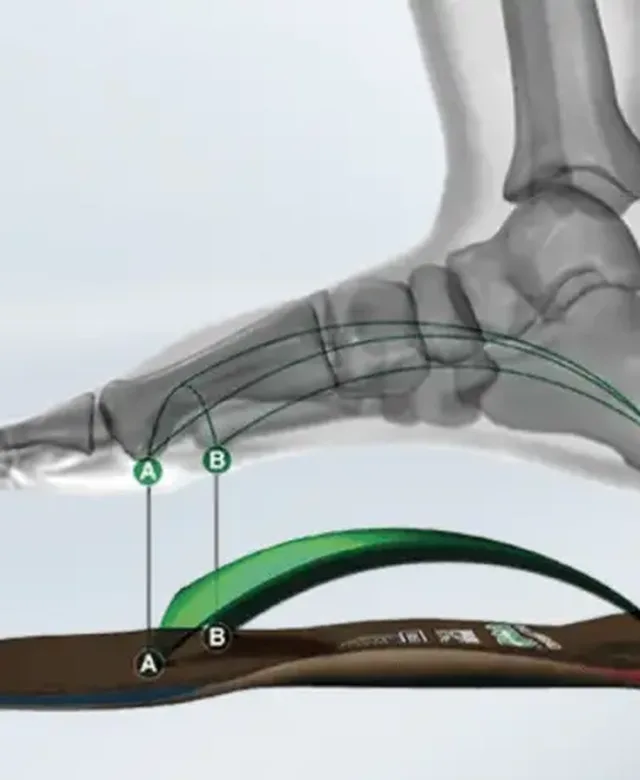
Custom orthotics tend to fit people carrying recurring pain that traces back to how they stand and walk: flat feet or a collapsed arch, a rigid high arch that never absorbs shock well, or uneven wear on the bottom of every shoe you own. If a drugstore insert has already been tried and hasn’t moved the needle, that’s usually a sign the fault is more specific than a generic pad can address.
The people this fits best are usually the same type: they’ve noticed the pattern themselves, on their shoes or in the ache that shows up in the same spot every time, and they want the actual mechanics corrected rather than another round of cushioning.
It’s not the right first stop for a diabetic foot needing specialized protective footwear, a suspected fracture, or a structural deformity that needs a podiatrist’s evaluation before anything else. In those cases we’ll refer you to the right provider first.
Good fit
- Recurring foot, knee, hip, or back pain tied to how you stand and walk
- Flat feet, a collapsed arch, or a rigid high arch
- Uneven wear pattern on the bottom of your shoes
- A drugstore insert that hasn’t made a difference
Not the right first stop
- A diabetic foot needing specialized protective footwear
- A suspected fracture
- A structural deformity needing a podiatrist’s evaluation first
Measure the fault first. Build the fix to match it.
“Scott got me to the start line healthy and I set a massive marathon PR!”David Smith · Zone PT patient
Questions, answered plainly.
A store insert is built to a shoe size. A custom orthotic is built to your foot, from a mold or scan taken during a gait and foot mechanics exam that identifies the specific way your foot loads, and the specific joints up the chain paying for it. That’s the difference between something that cushions and something that corrects.
The exam and cast or scan happen at one visit, usually less than an hour. Fabrication then runs through an outside lab, typically two to three weeks, and your fitting visit checks the fit against your actual mechanics and adjusts anything that needs it before you leave.
It depends on your plan and the diagnosis behind the recommendation. We’ll check your benefits before you commit to anything, and if coverage is limited, you’ll know the real cost up front instead of finding out on a bill later.
Most patients get three to five years out of a pair, depending on activity level and how much they’re on their feet. We check the shell and the correction at routine visits and let you know when the wear has caught up with the support.
Start with the exam that finds the actual fault.
Put it in writing.
Five short questions. A real person calls you back, usually within two business hours, with times that fit your week.
The people who end up filling this out are rarely in the worst pain of their life. They’re just done working around it, done picking the errand that doesn’t require the stairs. If that’s the stage you’re at, this is the part where you stop researching and start.
Consider it filed.
A real person will call you back, usually within two business hours, with appointment times that fit your week. Keep your phone nearby.
Can’t wait? Call (864) 263-7390 ⟶Easy to find. Easy to park.
In the neighborhood, with parking by the door. Come see the place before you commit, if you like.
The clinic · Zone Physical Therapy
Get Directions ⟶Opens in Google Maps