

Greer, SC · What we treat
Pre/postnatal pain in Greer.
A pull in your belly that stops you mid-step, a low back that’s ached since the second trimester, or a gap down the middle that’s still there months after delivery: a cause-first evaluation meets your body where it actually is, then a plan with an endpoint gets you moving through pregnancy, and back afterward, without bracing for it.
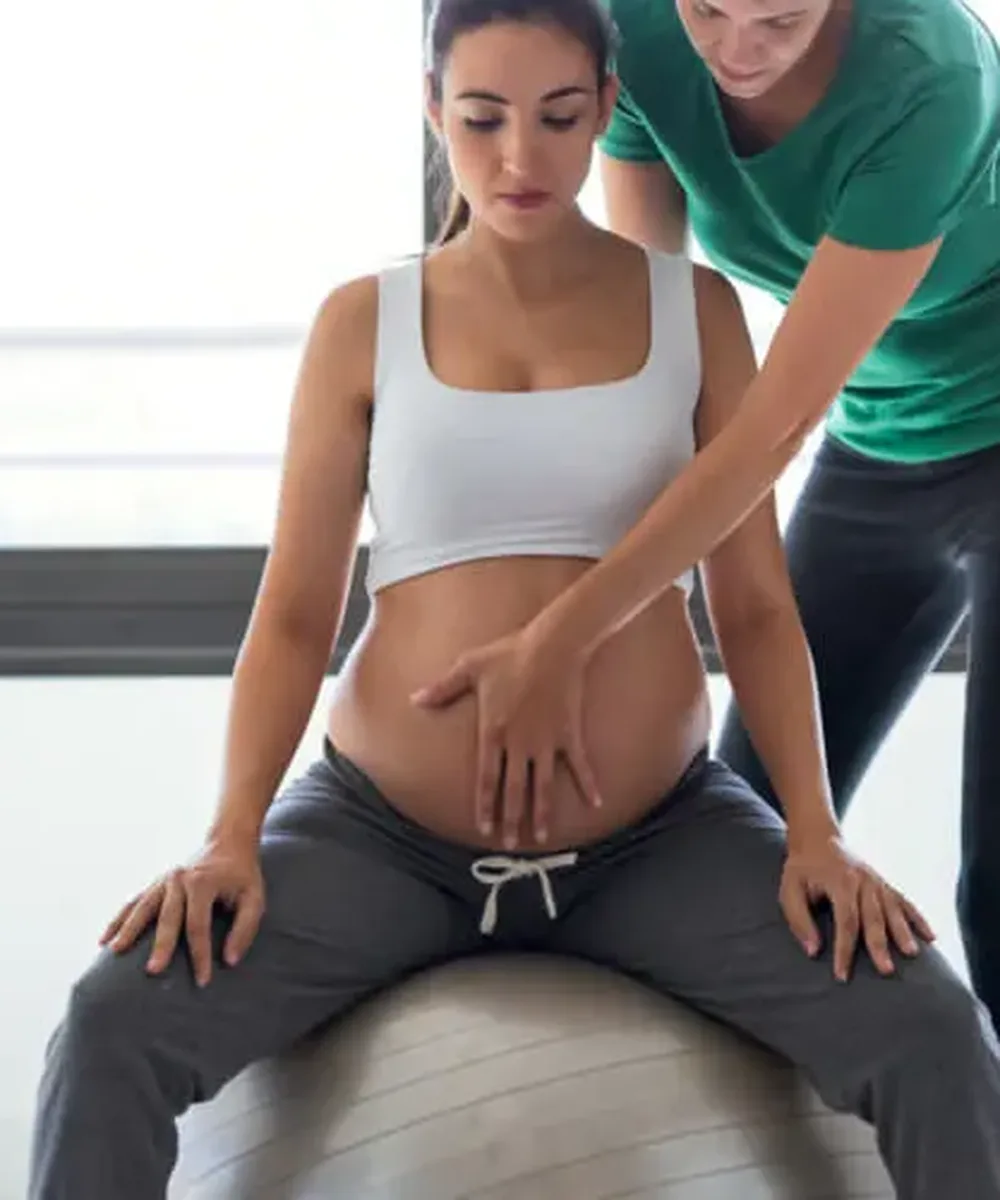
You’ve probably said one of these.
Nobody walks in describing a diastasis measurement they haven’t had checked. They describe days like these. Tap one that sounds like your week.
-
UsuallyRound ligament pain, common in the second trimester as the ligaments supporting your growing uterus stretch quickly with certain movements.
See how the plan adjusts by trimester ⟶ -
OftenPregnancy-related lumbopelvic pain, from a shifting center of gravity and hormonally loosened ligaments changing how your low back and pelvis share load.
See how manual therapy and bracing strategy help ⟶ -
UsuallyDiastasis recti, an abdominal wall separation that doesn’t reliably close on its own without targeted core retraining, no matter how much time has passed.
See how postpartum core rehab addresses it ⟶
- “I feel like I’m bracing my whole midsection just to sneeze.”
- “My doctor said this is normal for pregnancy. It might be, but it’s still not comfortable.”
- “I want to get back to running, but I don’t know if my body is actually ready.”
If two or three of those sound like your week, you’re not describing something you have to just push through. You’re describing a pattern we see often, and one an evaluation is built to explain.
Why does pre/postnatal pain happen?
There’s rarely one single cause, and it’s rarely something you did wrong. What we usually find, alone or in combination:
- Hormonal ligament laxity. Relaxin loosens ligaments throughout pregnancy to prepare the pelvis for delivery, which also changes how the low back and pelvis stabilize under load.
- A shifting center of gravity. The growing uterus alters posture week by week, often loading the low back and hips differently than they’re used to.
- Round ligament stretch. The ligaments supporting the uterus stretch with certain sudden movements, producing a sharp, specific pull rather than a general ache.
- Pelvic girdle and SI joint instability. The joints connecting the pelvis can become less stable as ligaments loosen, contributing to pain with walking or turning over in bed.
- Postpartum abdominal wall separation. Diastasis recti, along with pelvic floor changes from vaginal delivery or cesarean recovery, that don’t always resolve without targeted rehabilitation.
- Returning to exercise too quickly. Resuming running or lifting before the core and pelvic floor have been retrained to support that load again.
None of these are things you’re expected to sort out yourself, and most don’t require anything beyond a movement-based evaluation to start treating.
How do we treat pre/postnatal pain in Greer?
Treatment starts with a cause-first evaluation of how your core, pelvic floor, hips, and back are working together right now, whether that’s week 20 of pregnancy or month eight postpartum. From there, care moves through four named phases, adjusted for where you are in that timeline.
The plan’s endpoint is named at your evaluation and reviewed with you every phase, because the goal is a body that supports your pregnancy or your recovery, not a fixed number of visits.
Calm it down.
Manual therapy and positioning strategies to ease back, pelvic, or ligament pain, and gentle core and breathing reconnection in the early postpartum weeks.
Restore coordination.
Core and pelvic floor coordination work suited to your stage, whether that’s supporting a growing belly or retraining a diastasis.
Rebuild strength.
Progressive strengthening against standards you clear before moving on, building toward the lifting, walking, or running you actually want back.
Make it stay strong.
Testing before you’re cleared for full activity, then a home program that carries forward through the rest of pregnancy or into your next season of training.
What does getting better look like?
People who end up booking an evaluation here are rarely the ones who had a single dramatic moment of pain. More often, it’s a slower story: an ache that started around week 20 and was chalked up to “just pregnancy”, or a gap in the abdomen noticed in the mirror months postpartum and quietly worked around instead of addressed. If that’s closer to your version, you’re the typical patient here, not someone who waited too long.
Progress tends to show up in ordinary places first: standing at the sink without shifting your weight to one hip, rolling over in bed without that sharp pull, a core that feels connected again during a workout instead of vaguely absent. Left unaddressed, pregnancy-related pain and postpartum separation don’t reliably resolve with time alone; they tend to shape how you move for longer than the pregnancy or recovery itself lasts.
An evaluation turns “this is just what pregnancy feels like” into a plan with a specific estimate, reviewed with you at every phase.
Which services treat pre/postnatal pain?
Prenatal Therapy
Trimester-adjusted care for back, pelvic, and round ligament pain, with a plan that changes as your pregnancy does.
02Birth Preparation
Pelvic floor and positioning work in the final weeks aimed at making labor and delivery more manageable.
03Postpartum Care
Core, pelvic floor, and diastasis recti recovery in the weeks and months after delivery, however you delivered.
04Return to Exercise Postpartum
A graded path back to running, lifting, or your sport, cleared by standards rather than by the calendar alone.
“I came to Scott after battling many seasons of groin pain and he came up with a great plan that helped me tremendously.”Hailey Anderson · Zone PT patient
Questions, answered plainly.
The things people ask on the phone during pregnancy and after, written down.
You don’t have to just wait it out. Pregnancy-related back and pelvic pain responds well to manual therapy, targeted strengthening, and bracing strategies suited to your changing body, and treatment adjusts as you move through each trimester. It won’t be exactly the same plan at 12 weeks as it is at 32, and that’s by design.
Many people start within the first few weeks after clearance from their OB or midwife, though the timeline depends on your delivery and recovery. Early sessions typically focus on gentle core and pelvic floor reconnection rather than heavy exercise, then build from there as your body is ready for more.
Some abdominal separation narrows on its own in the first weeks postpartum, but for a meaningful number of people it doesn’t close fully without targeted core retraining, regardless of how much time passes. An evaluation measures the gap and tension across it, then builds a progression that addresses it directly instead of hoping it resolves with general exercise.
For most pregnancies and most postpartum recoveries, yes, with modifications suited to the trimester or to how your core and pelvic floor have recovered. The evaluation identifies what to adjust and when to progress, so you’re moving with a plan rather than guessing or avoiding activity out of caution alone.
Start with a cause-first evaluation for your pregnancy or postpartum recovery.
Put it in writing.
Five short questions. A real person calls you back, usually within two business hours, with times that fit your week.
The people who end up filling this out are rarely in the worst pain of their life. They’re just done working around it, done picking the errand that doesn’t require the stairs. If that’s the stage you’re at, this is the part where you stop researching and start.
Consider it filed.
A real person will call you back, usually within two business hours, with appointment times that fit your week. Keep your phone nearby.
Can’t wait? Call (864) 263-7390 ⟶Easy to find. Easy to park.
In the neighborhood, with parking by the door. Come see the place before you commit, if you like.
The clinic · Zone Physical Therapy
Get Directions ⟶Opens in Google Maps